A hybrid installation-performance exploring light, shadow, and non-verbal storytelling
🎬 Precedent Work: SPOONS
SPOONS emerged from a cross-disability screen dance residency, connecting the lived experiences of five artists.
Each of us created our own scene centered around the shared motif of the spoon, reinterpreting it as a symbol of
resistance and disability pride.
In my contribution, I rendered the spoon as hand-folded paper origami. This was a deliberate artistic statement: the
"spoon"—often seen only as a tool to measure our limitations—is not only something made for us, but also something
that can be made by us.
This philosophy, first explored with the origami spoon (2023), evolved into the Teapot Lantern series (2026). While the spoon
measures energy, the teapot symbolizes the adaptive plasticity of identity, showing how cultural rituals can be remade using
the materials at hand in new environments.
This work evolved from the screen into two distinct live solo performances:
📍 Vine Art Festival (2023): A daytime outdoor performance featuring live painting. Working within natural light, I used Tai Chi motions to sense the energy flow of the spoons through rice paper and "rabbit" banners, which were utilized as tied curtains.
📍 Vancouver Outsider Arts Festival (2024): A dark theater performance where I expanded the work into shadow dance. I integrated experimental live-object projection to animate the spoons and vases directly onto the banners, creating a layered visual narrative.
In both iterations, movements were memorized arrangements of improvised gestures with intentionality. As an accessibility measure, I articulated the gestures with poetic tone and audio description. The set included a fabric banner painted by me years ago featuring a "mother rabbit" with her offspring on a seed-pod boat.
SPOONS directly informs Eco-Illuminessence by bringing shadow improvisation, object animation, and accessible, non-verbal storytelling into the heart of the installation-performance.
🌳 Material Resistance: Balancing Organic & Synthetic Resilience
Material resistance is an ongoing inquiry in my practice. This research began
with a shift from summer lantern builds—such as Vancouver’s Illuminares festivals
in the mid-2000s—to autumn and winter installations for festivals like
Renfrew Ravine Moon Festival and winter solstice lantern events.
This inquiry is informed by early professional training as a medical laboratory
technologist (2000–2009), followed by long-term work in health IT.
I approach materials as an experimenter—testing how organic matter and
post-consumer waste respond to rain, wind, and repeated outdoor exposure
across the West Coast.
I. Organic Preservation with Fabric — The Rabbit Children
Early paper-and-bamboo lanterns absorbed rain quickly during outdoor use.
During a three-day rain stress-test at the Out There Art Festival (2010),
I began experimenting with fabric as a protective layer for mulberry paper
calligraphic brushwork.
By layering translucent fabric above and below the paper—forming a
fabric “sandwich”—the ink-work is preserved while allowing
the lantern to withstand prolonged rain exposure.
II. Robust Skeleton & Hand-Sewn Repair — The Rabbit Mother
As traditional skin-on bamboo slats became difficult to source sustainably,
I shifted toward locally available post-consumer garden materials.
The Rabbit Mother (2023) combines a neglected hanging flower basket with
abandoned tomato cages.
I moved away from white PVC glue used in summer builds, which fails under
prolonged rain. Instead, I employ hand-sewn domestic repair techniques,
using moisture-resistant thread and lavender stems to create a form that has
survived four festivals and multiple outdoor activations.
III. Material Stress & Hybrid Resilience — The Feminist Dragon
The Feminist Dragon (2024) extends material testing through a hybrid structure
composed of garden branches, grapevines, rosemary stems, and a
collapsed mesh laundry basket as its armature.
Organic materials provide scent and form but require reinforcement over time.
The dragon’s complex curvature demanded intensive hand-sewing and adaptive
repair, drawing on techniques learned through large-scale lantern construction.
IV. Post-Consumer Casting — The Turtle
The Turtle (2025) represents the most weather-resistant iteration in my practice.
Using semi-casting methods with upcycled plastics, it demonstrates
how industrial waste can be reshaped into durable sculptural forms for
repeated outdoor use.
Remade Surfaces & Lineage
Owl and Whale
My lantern-making roots lie in childhood play and co-making with my mother,
where repair, improvisation, and reuse were learned informally and through necessity.
Lantern surfaces in my practice are often remade year after year.
In one instance, my mother repaired damaged paper owl lanterns with fabric without
consulting me. What initially felt like a disruption later revealed itself as part
of a shared lineage of care—where preservation matters more than authorship.
In 2003, I attended a one-day master session organized by the nadian cultural society
. This was not paid work but revise the making lantern with paper-coated wire and fabric
are comptemety chinese lantern.
My skills were primarily honed through volunteer-based building with
Vancouver Illuminares during the mid-2000s. These projects demanded collaborative
engineering, rapid repair, and real-world weather resilience.
The Whale and floating airplane lanterns
(circa 2005–2006) remain works I am especially proud of.
This lineage—rooted in family repair, volunteer labor, and collective making—
continues to shape how I approach lanterns as living surfaces that carry time,
care, and return.
🎋 Ancestral Engineering: The Hong Kong Roots
My foundation is rooted in the "primitive" lantern-making traditions of Hong Kong. This is my primary technical lineage: using bamboo slats for framing, hand-torn strips of mulberry rice paper as ties, and sticky rice paste as the binding glue.
This lineage was learned informally through necessity and childhood play with my mother. It established my understanding of lanterns as living surfaces—objects that require constant repair and carry intergenerational care. A pivotal moment of this lineage was when my mother repaired my paper owl lanterns with fabric; an act that prioritized preservation over authorship.
🛠️ Material Redefinition: The 2003 Transition
In 2003, a session with the Taiwanese Canadian Cultural Society redefined "authenticity" through modern materials. This was not my first exposure to lantern-making, but rather a shift in material science: replacing bamboo and rice paste with paper-coated wire, synthetic fabric, and hot glue.
This modern methodology provided the bridge between traditional form and the durability required for the Canadian climate, eventually leading to my immersive work with Vancouver Illuminares (circa 2005–2006) on large-scale projects like the Whale and Floating Airplane.
🔬 Regional Validation: Geographic Stress-Tests
Today, I synthesize these lineages to conduct Geographic Stress-Tests. While Eco-Illuminessence was centered in Victoria, the structural engineering was validated through sensing walks to monitor how these hybrid materials respond to BC's micro-climates.
🌊 West Vancouver: Ambleside
Test: High-wind resistance and salt-air exposure.
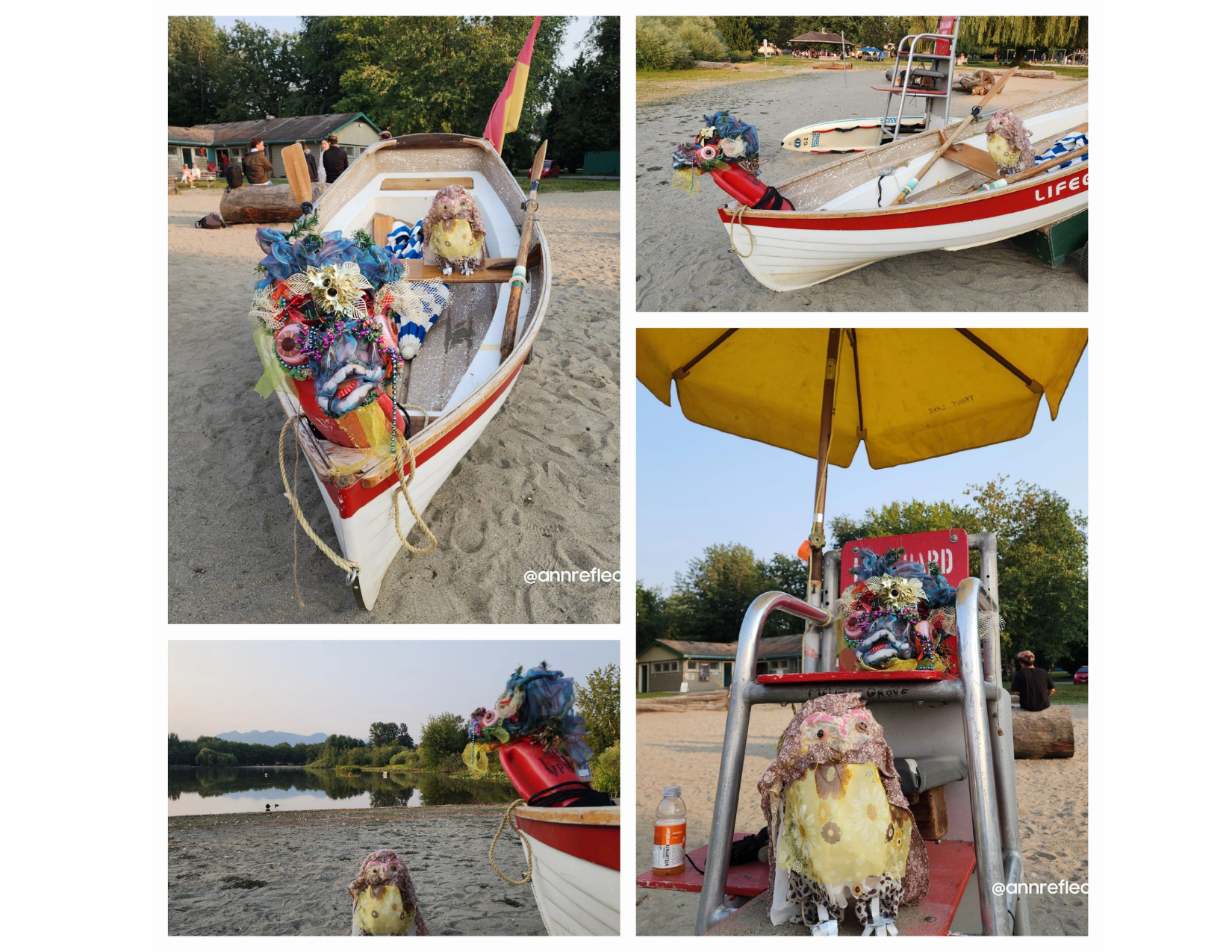
The Dragon Hat interacted with shoreline geometry and lifeguard boats to monitor structural tension in coastal environments.
🌲 East Vancouver: Trout Lake
Test: Urban transit corridors and day-trip mobility.
Conducted sensing walks with the Owl and Dragon to test the "fabric sandwich" technique during transit-corridor crossings.
🌸 Target 2026: Burnaby (Deer Lake)
Goal: Burnaby Blooms 2026.
Proposed material inquiry applying the Rabbit Mother armature to suburban park geometries to test moisture-wicking in forested settings.
🔬 Field Proof: The Neuro-Sensing Walks
My engineering process is validated through site-responsive sensing walks across real-world conditions like Science World and Ambleside Beach.
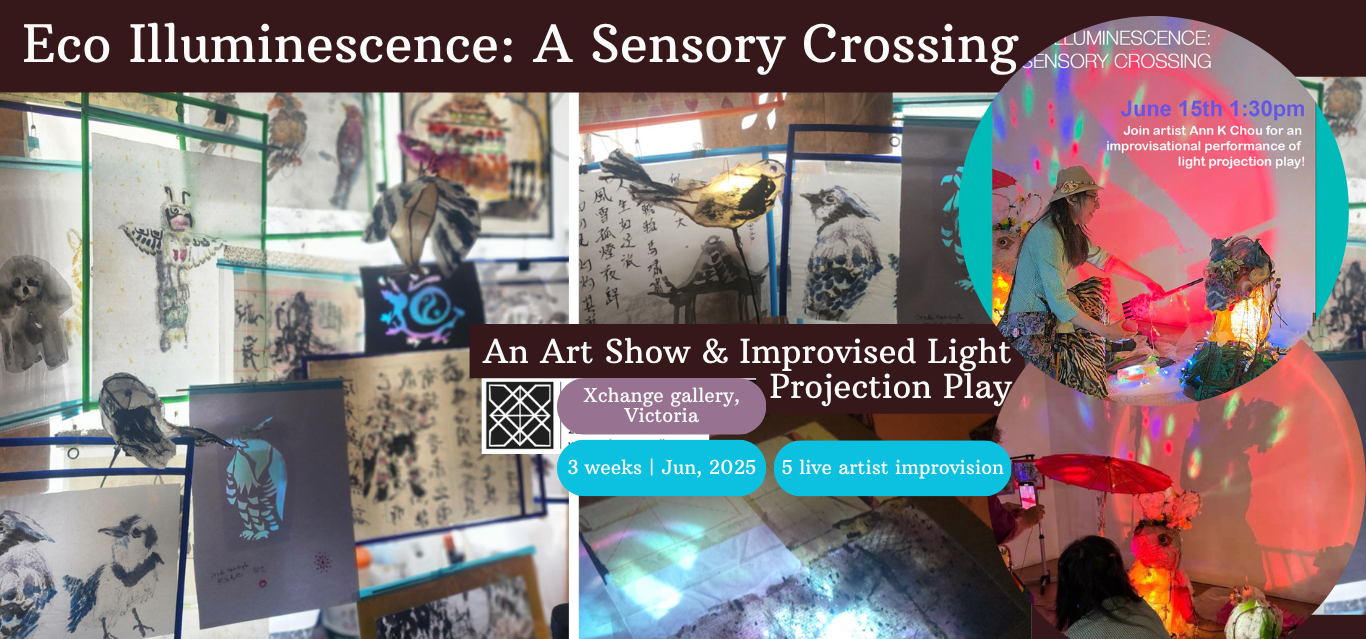
Eco-Illuminessence: A Sensory Crossing is a cross-disciplinary body of work developed between 2024 and 2025, marking the artist’s first foray into performance. Rooted in her visual installation practice, this evolving series bridges sculptural form and live gesture—inviting audiences into a world of low-tech enchantment and quiet storytelling through light, shadow, and movement.
Presented through two in-person showings and three livestreamed sessions—including a hybrid event at Xchanges Gallery (Victoria, BC)—this early iteration served as both a public offering and a developmental sketch. It became a space of experimentation, reflection, and transformation.
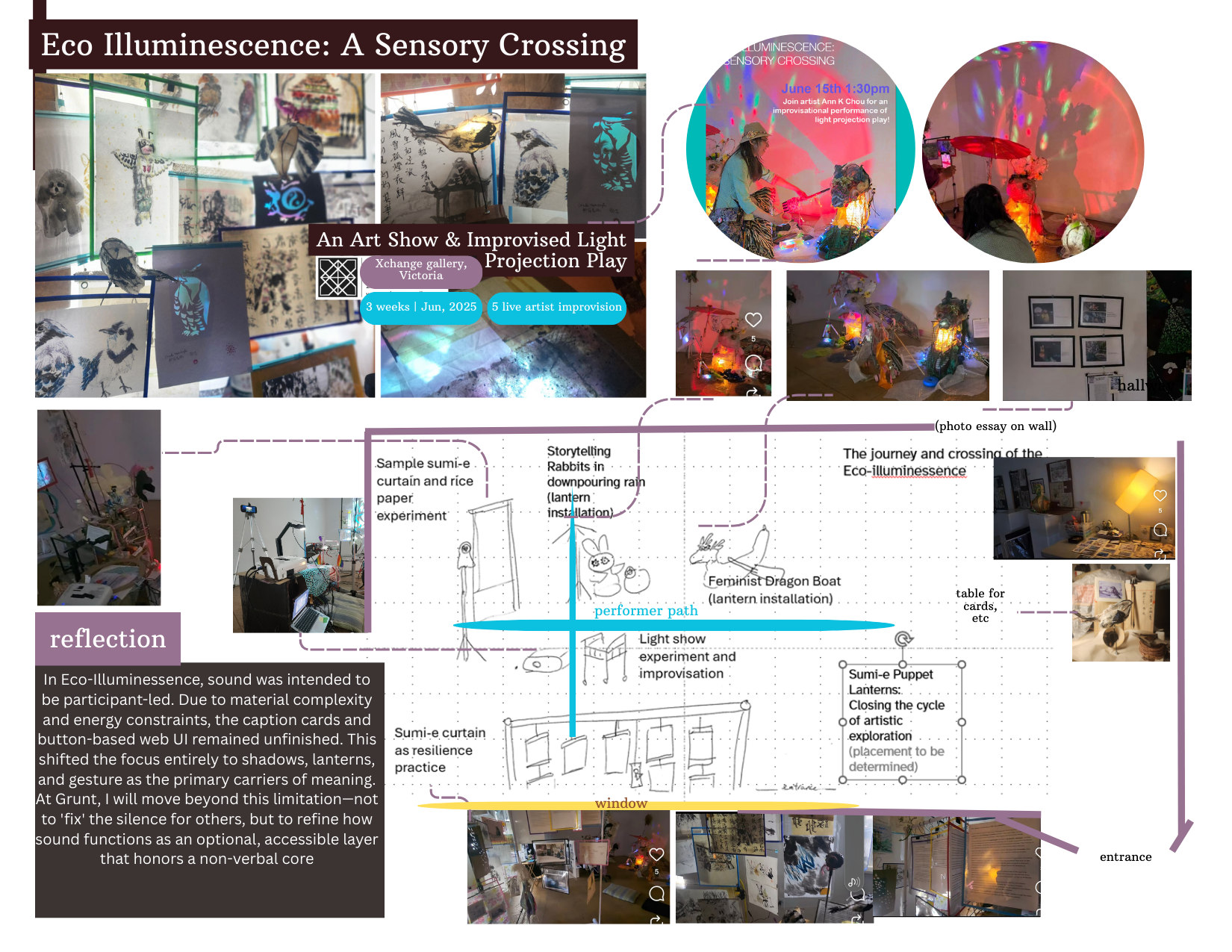
Multi-compoent Ecoilluminescence as in Jun 2025 - summary floor map with pictures of compoents and reflection.
🌘 The Visual & Sensory Core
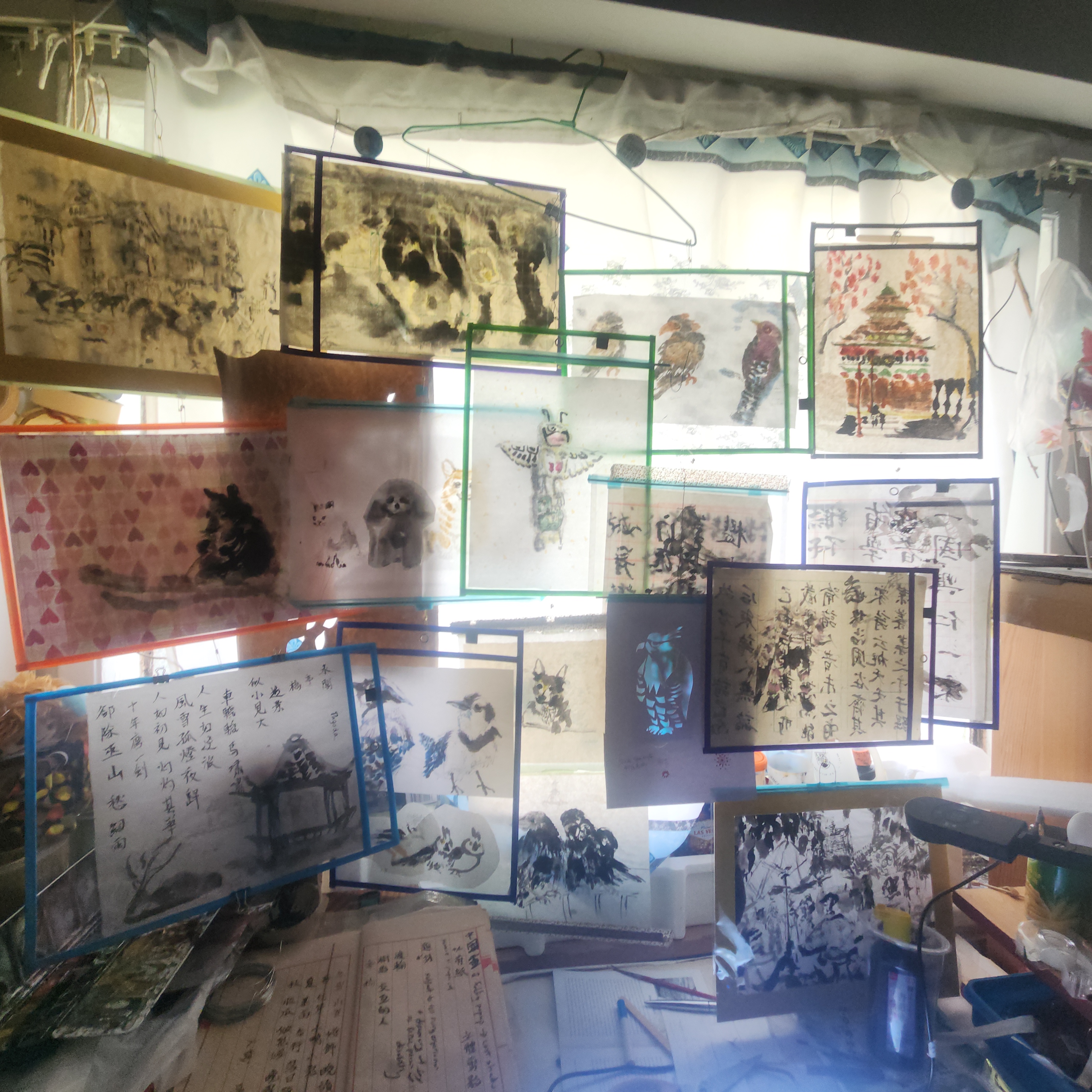
This immersive project combines traditional sumi-e paintings, animal-shaped lanterns, upcycled garden waste objects, and semi-translucent fabric sculptures. It invites participants to explore light, shadow, and tactile elements in a layered sensory crossing.
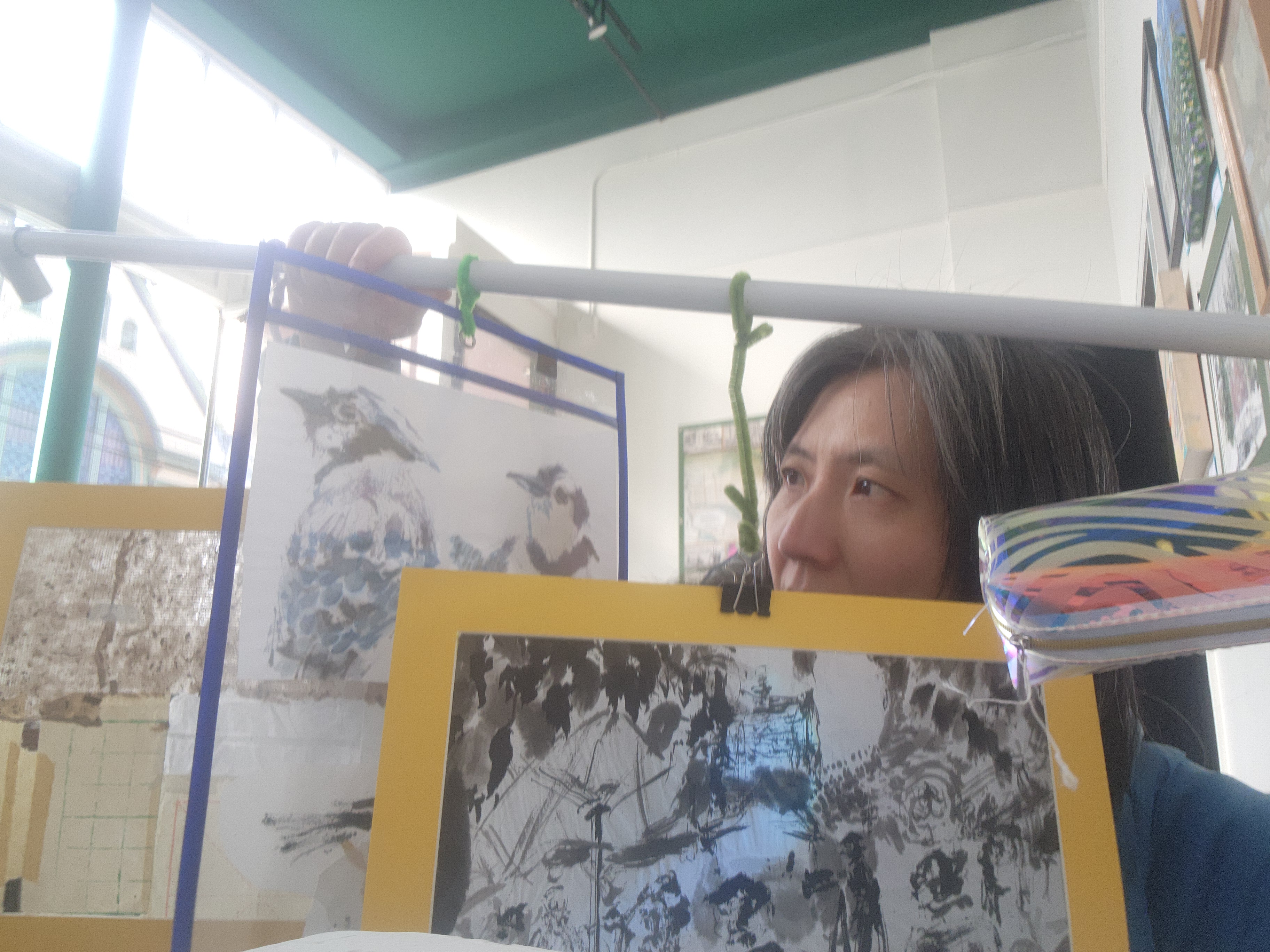
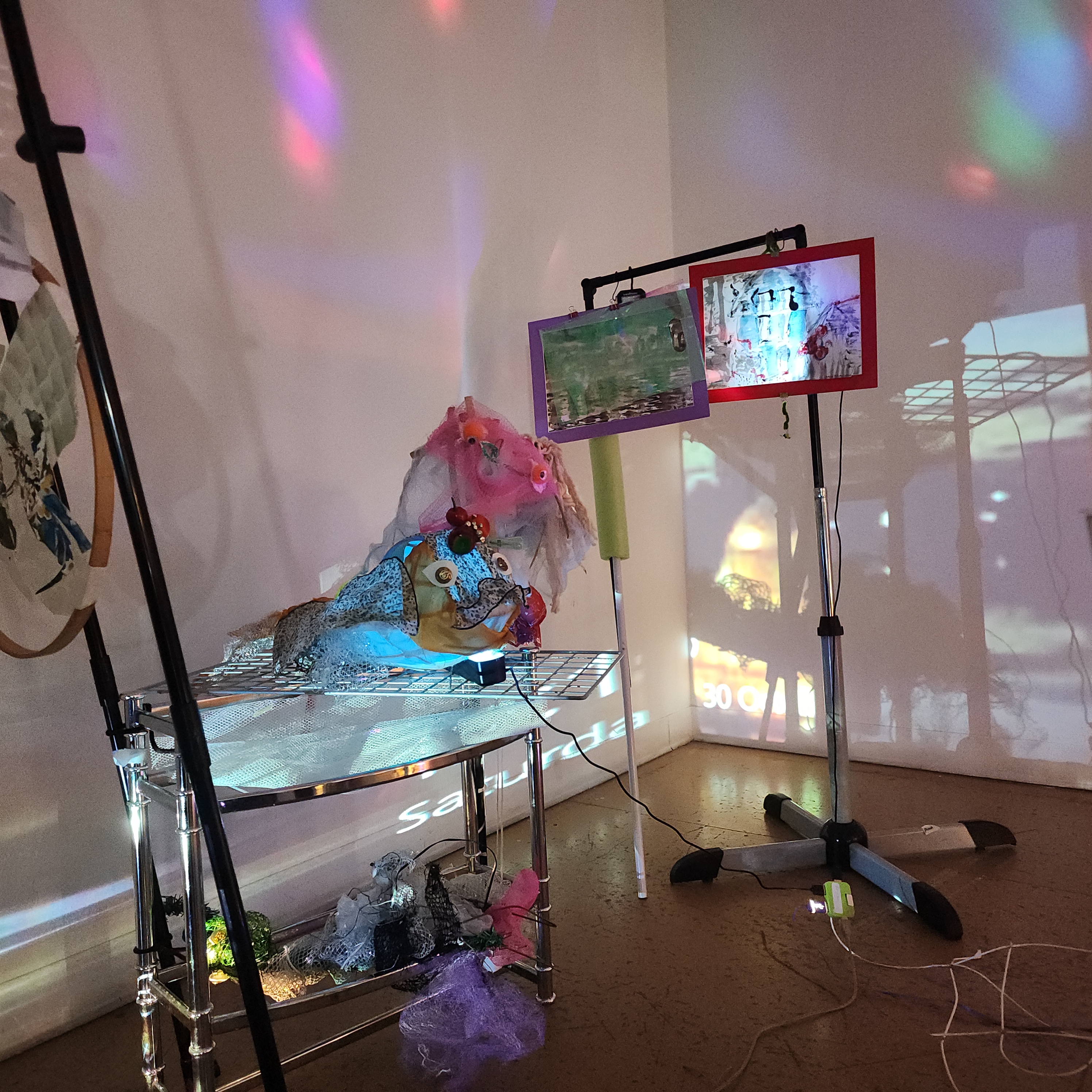
The sumi-e curtain is composed of ~70 clear 11x14 pockets, each holding A4 rice paper ink sketches created during the COVID lockdown via virtual plein-air challenges and later on-location plein-air painting. Visitors are encouraged to interact with the curtain and lanterns using light and objects from a participant experience station (glass, bamboo sticks, patterned objects, mesh).
🦋 Lanterns & Eco-Art Approach
The lanterns are semi-hard sculptures and stage characters;
their shadows perform alongside the artist. Eco-materials adapt to West Coast wet weather:
rosemary branches, later reinforced with wire, and lavender stems adorn daytime sculptures.
Lanterns, props, and the Sumi-e curtain all participate in interactive improvisation
—no rehearsal, experiments with light, position, and shadow gesture determine the performance path.
This approach prioritizes sustainability, accessibility, and ecological imagination—turning found, upcycled, or natural materials into poetic visual and performative objects.
This practice evolved in 2026 with the Teapot Lantern series, first showcased in the Plasticity exhibition at Habit Coffee.
The teapot symbolizes cross-cultural exchange and comfort, while also reflecting the adaptive plasticity of identity. By transforming everyday disposable materials—such as Starbucks cups and grocery mesh—into ritual vessels, the work demonstrates how consumer waste can be reshaped into luminous, tactile forms.
In both the 2025 installation and the 2026 teapots, these sculptures act as stage characters, with their shadows performing alongside the artist.
Whether responding to theatrical projections or the sideways light of a local café, the objects engage in interactive improvisation, where shadows and light collaboratively guide the narrative.
✦ A Sensory Crossing: The Performative Layer
The performative layer of Eco-Illuminessence was developed in situ through a series of
improvisations, using the lantern installation as the stage and the lantern characters as social
beings. This process emerged after the first week of exhibition, as the artist explored and
responded to the gallery’s light conditions, the challenges of managing darkness, and the interplay of
handheld lights, sunset illumination, disco light and projections from a book camera.
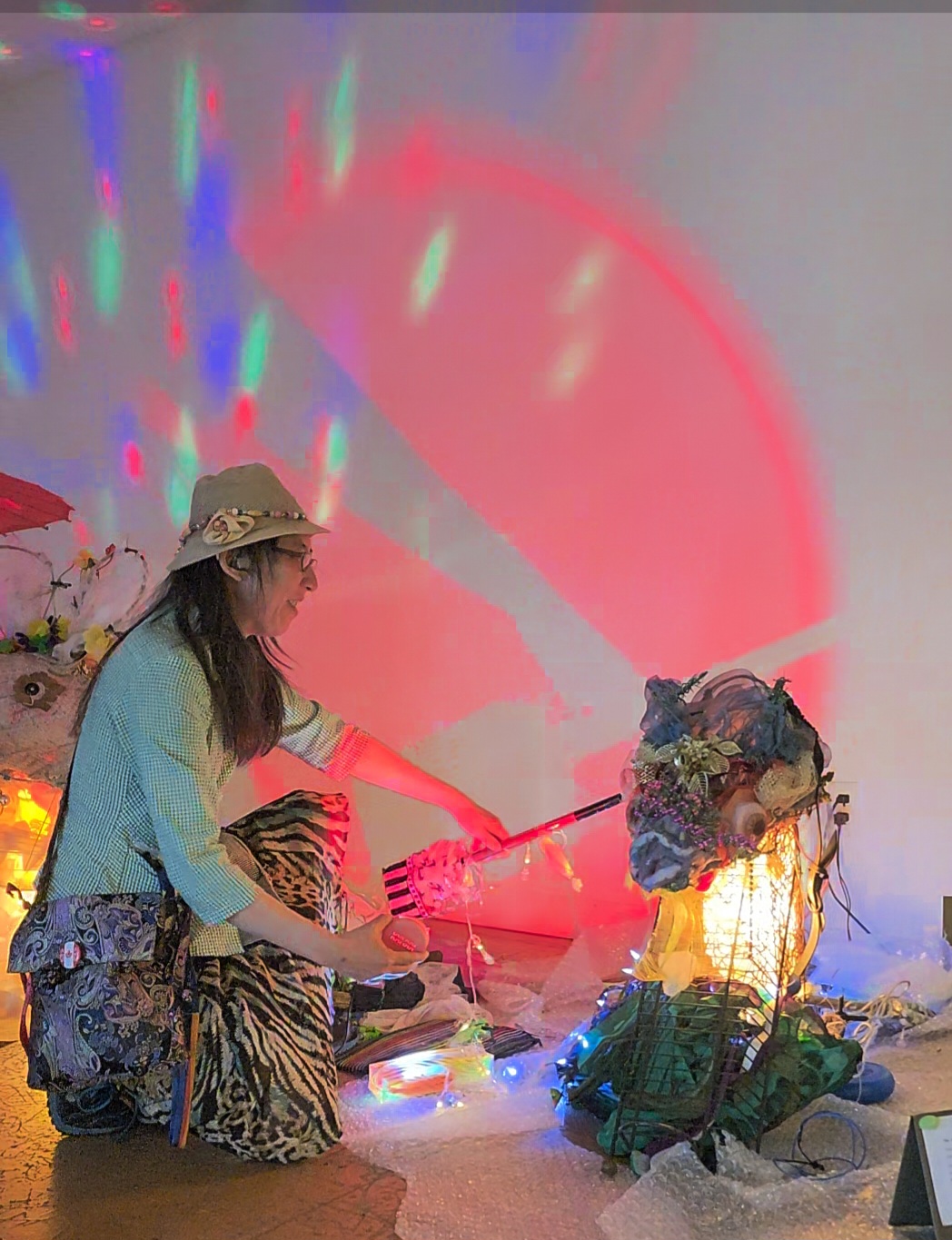
In performance, the fabric lantern sculptures became living puppet-characters—animated not
through conventional puppetry, but through light manipulation, shadow play, and direct interaction.
Handheld lights and live cameras allowed the artist to mobilize shadows, transforming static forms into dynamic silhouettes.
A live camera pointed at a flat, illuminated surface enabled direct sumi-e painting. This surface functioned simultaneously
as a projection canvas and performance stage. The live feed was projected onto surrounding surfaces, creating a layered visual field.
Participants were invited to co-create moments through movement, layering, and manipulation of light.
This improvisational layer—a sensory crossing—allowed the visual art to speak back poetically through gesture and ephemeral
choreography. It marked a turning point in the artist’s practice: a conversation between stillness and motion, installation and performance, object and presence.
A parallel component of Eco-Illuminessence explored a poly-sensory, neurodivergent creative process as modular lanterns
traveled through urban
and natural landscapes. This journey was presented to exhibition audiences as a photo documentation, capturing encounters
before, during, and after the exhibition.
Neuro-sensing is an integral part of my creative process. Therefore, all lanterns are made lightweight and modular—designed
to be easily disassembled and reassembled on-site. They traveled via buses, ferries, and public spaces, functioning as both
invited and uninvited guests of festivals, forming part of my photo-making journey.
I actively engage with the lanterns, integrating them into the environment. For example, the dragon hat lantern interacts
with urban geometry, climbing racks, gate stoppers, lines of Garry oak branches, lifeguard boats, and the varied habitats
along Ambleside Beach (West Vancouver). Water bodies, such as ponds at Governor’s House, provide reflective surfaces that
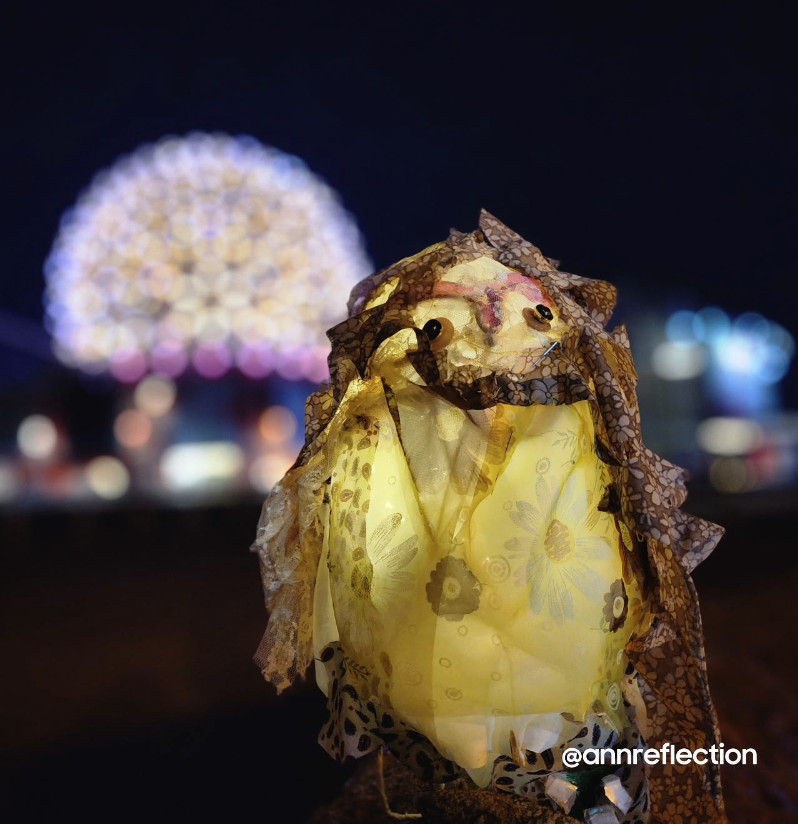
reveal new forms, while nighttime photos capture landmarks like Science World mirrored on puddles.
✦ Component 4: From Ink to Lantern — 2D-to-3D Sumi-e Transformation
As the fourth major component presented during the Eco-Illuminessence exhibition, this piece complemented the traveling lanterns, in-gallery lantern installations, resilient backlit sumi-e curtain, and participant station. It explored the cyclical process of moving between visual installation and performance.
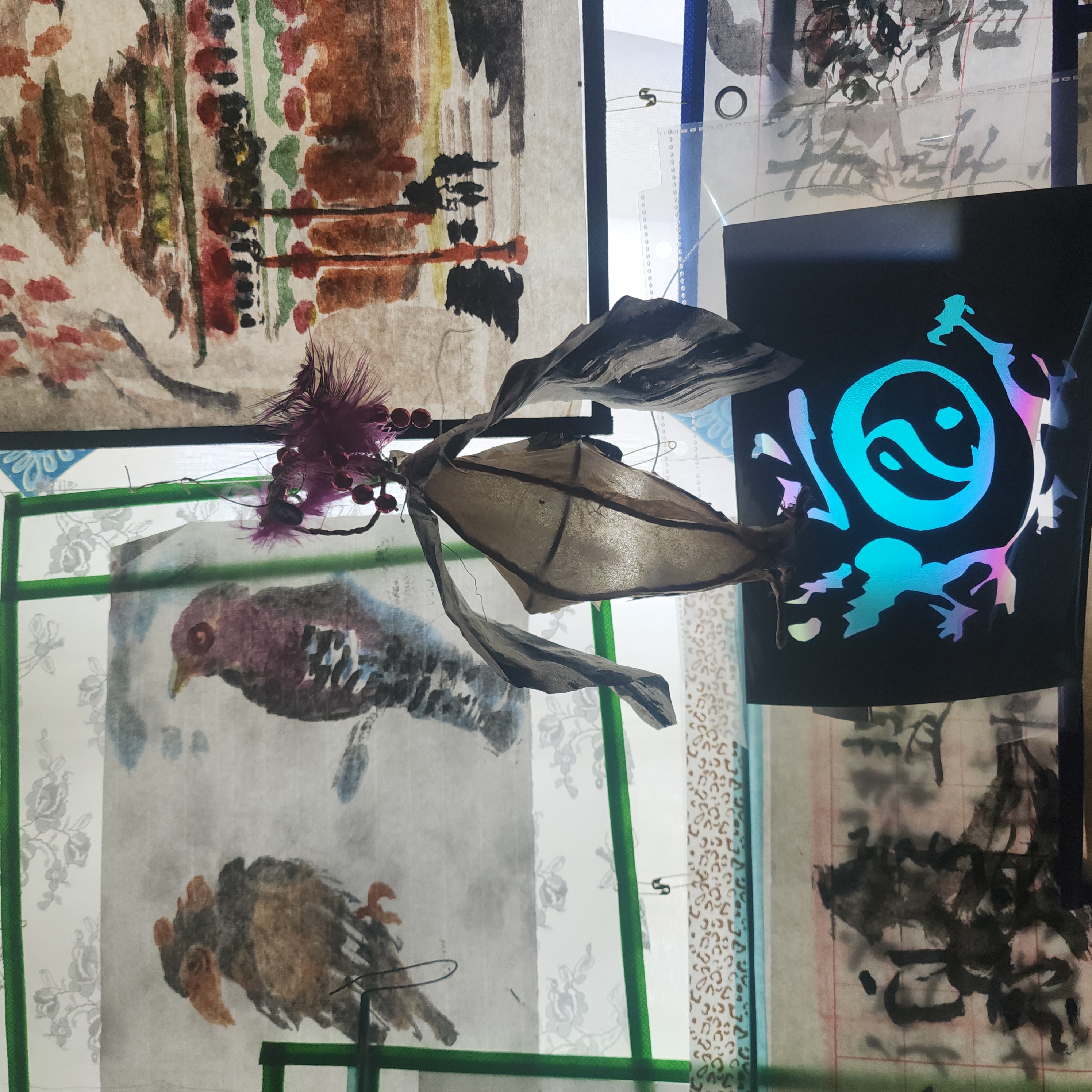
Small elements, like the ink-brush bird puppet, illustrate this interplay. In transitioning from 2D form to 3D form, and from visual art to performative practice, I asked:
What if a sumi-e brushstroke could become a sculptural form?What if a shadow could be folded into a lantern?
This inquiry inspired a new direction: transforming 2D sumi-e ink gestures into 3D lantern structures. Brushstrokes once confined to paper were reimagined as translucent forms—curved, stitched, and suspended. The sumi-e curtain became not just a projection surface, but a sculptural archive of movement and memory.
This bi-directional crossing—between drawing and object, between shadow and form—continues to shape the evolving language of visual poetics in my practice, connecting improvisation, installation, and audience engagement.
🎞️ Highlights in Motion
Below are some brief clips capturing moments of improvisation and light-play. Video of full performance is at the bottom of the page.
📺 Session 2: Rough Cut Excerpt
Description: Eco-Illuminessence is an access-led performance-installation using animal-shaped lanterns, shifting light, shadow, and silence to create non-verbal and spoken narrative experiences. Structured as a visual poem, it unfolds through movement, image, and sensory cues, connected by rhythm, spatial relationships, and audience presence rather than fixed spoken language.
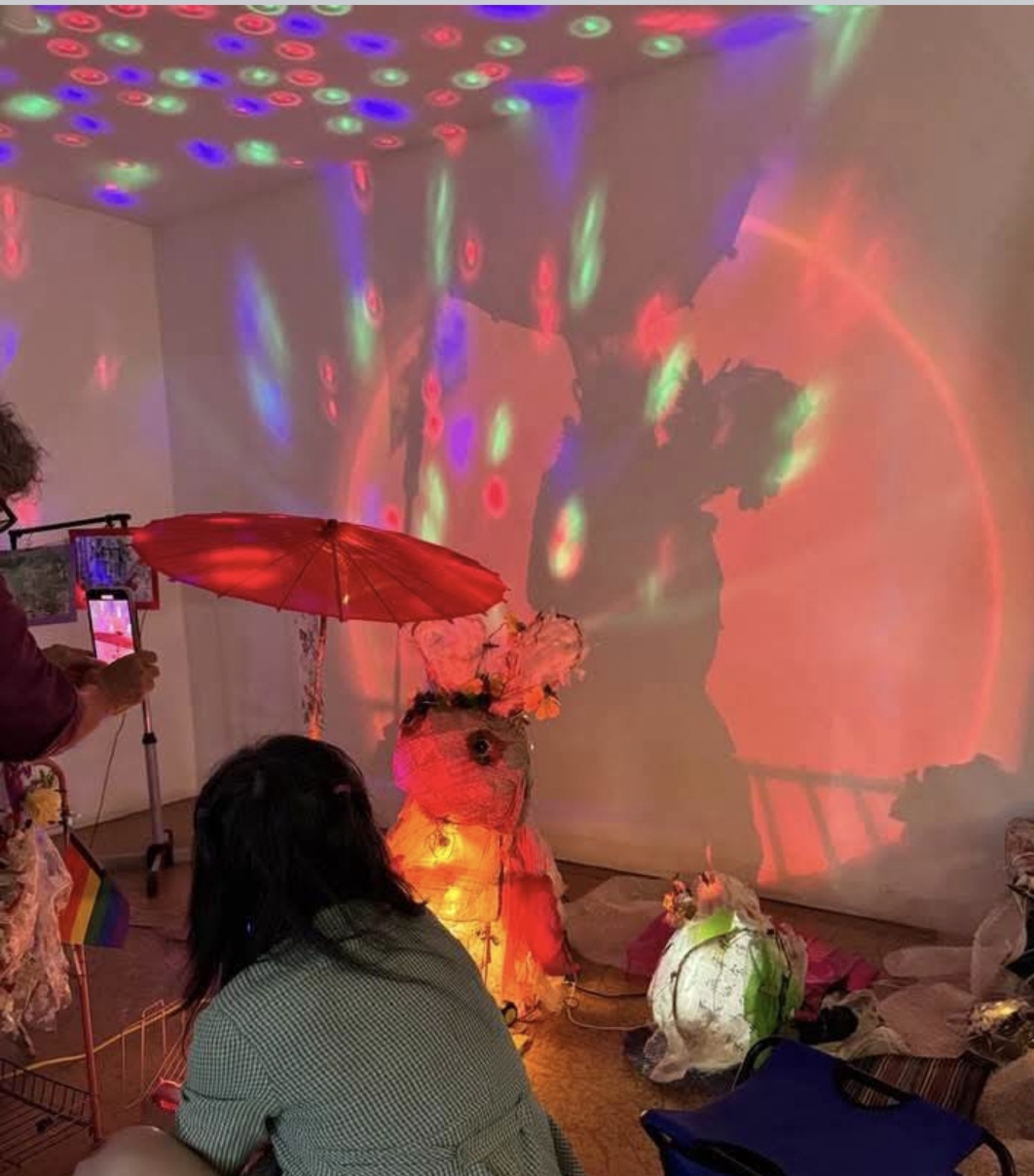
This video excerpt is a rough edit from Session 2, Camera 1 of 3, showing several key components. The clip begins with live painting on sumi-e paper, projected onto the wall. Using multiple light sources—including a book projector and rainbow/sunset lighting—the artist manipulates brush ink and objects, transforming marks into rain over an umbrella. Staged elements include the rabbit mother with umbrella, paddle, Feminist Dragon Boat, bird, whale, bamboo with leaves, and two mini curtain stands, demonstrating how shadows animate lantern characters.
Access note: This clip includes improvised speech without captions. Dual-language captioning and other accessibility strategies were developed and tested in later performances, as part of the ongoing research trajectory. The ideas for captioning, reverse captioning tools, and Draw-Aloud Symptom/s (DAS) integration emerged after this performance and remain in development. The artist aims to prototype and gather feedback during the residency. Some elements—such as merging DAS with lantern-based social characters—are exploratory and may extend beyond the six-week residency to allow for iterative development.
✨ Descriptive Details & Photo Captions (section to be completed)
🐇 Rabbit Mother Lantern with Umbrella
Installed fabric sculpture of a rabbit mother holding an umbrella. She stands as a gentle presence—part guardian, part storyteller—whose silent silhouette flickers across the space in folds of light.
🖌️ Live Sumi-e Ink Painting on Projection Surface
The artist paints directly onto rice paper laid over a lit surface. Each brushstroke becomes part of the performance—projected in real time and interacting with lantern characters and props.
🐟 Small Lantern Figures in Motion
Handheld lantern creatures glide across the space. Animated by internal light and the shadows they cast, they suggest multispecies kinship in a dance of silhouettes.
✋ Interactive Play with Light and Surface
Participants co-create scenes by moving light sources, draping fabric, and layering paper. Every gesture adds to an evolving light story that invites touch, presence, and care.
🖋️ Shadow-Texture Poem
Cut-outs, sumi-e ink paintings, and marked transparencies shift between motion and stillness. They form a layered visual poem of natural elements and quiet reflection—accessible without sound or language.
🔍 Explore the Installation Up Close
Click a tag below to explore selected glimpses from Eco-Illum’s creative evolution.
📺 Full Performance Recording
Watch the full improvised light projection play recorded at Xchanges Gallery (June 21, 2025).
Video credit: Edited by Theo Gardner| Camera: Theo Gardner
🌟 Credits & Acknowledgments
Artist: Ann K. Chou
Mentorship: Tim Gosley (shadow performance, moving-light technique)
✦ Next Step: Returning to Non-Verbal Roots with Sound Fluidity
While briefly exploring audio effects, spoken word, and live music, the process reaffirmed a commitment to
non-verbal, sensory-rooted expression. As a hard-of-hearing artist, I focus on visual poetics,
tactile interaction, and embodied storytelling, creating work that is accessible without reliance on language or sound.
In 2026, I continue experimenting with shifting light to animate stationary forms, letting narrative emerge through shadow,
texture, and vibration. In Eco-Illuminessence, visuals carry the story, while live, improvised English—delivered
with a d/Deaf accent—can be difficult for audiences to follow in motion.
Prior to the finale performance on June 21, I prototyped web-based buttons and physical “pop-cards” to explore reverse captioning,
making spoken English an optional, participant-led layer over visual and tactile meaning. Material and energy constraints limited
full realization, but this remains a key area for development.
Post-production raised another challenge: translating English captions into Hong Kong-style Cantonese while preserving playfulness
and cultural nuance, exemplified by a story of water exploration with my parents. Where possible, I hope to co-develop dual-language
captions as an artistic, rather than corrective, choice.
Alongside lantern-based performance, my ongoing Draw-Aloud Symptom (DAS) protocol—a “visual wandering” of past, present, and imagined
narratives—explores how participants’ visual timelines merge with lantern characters to deepen agency.
My overarching goal is to create spaces where meaning emerges through vibration, touch, and pictorial literacy, making spoken language
one layer among many. I aim to pause “masking,” follow natural rhythms, and co-learn how multisensory, participant-led strategies
expand accessibility and shared understanding.